Wednesday, July 6, 2016

Has Science Discovered God?

Einstein didn’t believe it was possible.
Stephen Hawking said it might be the greatest scientific discovery of all time.
What discovery has baffled the greatest scientific minds of the past century, and why has it caused them to rethink the origin of our universe? New, more powerful, telescopes have revealed mysteries about our universe that have raised new questions about the origin of life.
Has science discovered God?
But wait a minute! Hasn’t science proven we don’t need God to explain the universe? Lightning, earthquakes and even babies used to be explained as acts of God. But now we know better. What is it about this discovery that is so fundamentally different, and why has it stunned the scientific world?
This discovery and what molecular biologists have learned about the sophisticated coding within DNA have many scientists now admitting that the universe appears to be part of a grand design.


Friday, April 22, 2016

Oldest Viking Crucifix Uncovered in Denmark

A solid-gold cross depicting Jesus with his arms outstretched may be Denmark's oldest crucifix, dating back more than 1,100 years.
The gorgeous pendant was unearthed in March by a hobbyist with a metal detector. Found in a field on the island of Funen, Denmark, the Viking jewelry piece may have been worn by a Viking woman, according to the Viking Museum at Ladby, where the pendant was on display.

Hubble telescope snaps stunning pic for its 26th birthday

Time to add another gorgeous space photo to the Hubble Space Telescope’s list of greatest hits. For the orbiting observatory’s 26th anniversary in space, astronomerssnapped a picture of the Bubble Nebula, a seven-light-year-wide pocket of gas being blown away by a blazing massive star about 7,100 light-years away in the constellation Cassiopeia.
The star responsible for the bubble is young, just 4 million years old, and about 45 times as massive as our sun. It is so hot and bright that it launches its own gas into space at more than 6 million kilometers per hour. The vibrant colors in the nebula represent the elements oxygen, hydrogen and nitrogen.

Irish-based scientists make superbug breakthrough

A new discovery by scientists in Ireland could stem the spread of deadly superbugs that are predicted to kill millions of people worldwide over the coming decades.
A team has found an agent that can be baked into everyday items like smartphones and door handles to combat the likes of MRSA and E coli.
The nanotechnology has a 99.9 per cent kill rate of potentially lethal and drug-resistant bacteria, the scientists said.

William Reville: Is there life beyond Earth?

Two of the largest questions confronting science are: (a) how did life begin on Earth, and (b) does life exist elsewhere in the universe? Although we think we know the answer to the first question in principle – life spontaneously arose through the self-organisation of simple chemical building blocks – we remain a long way from a detailed understanding of the process. But, if our understanding of the origin of life on Earth is correct, then it seems inevitable that the vast universe beyond Earth also teems with life. Current research in this area was summarised by Jeffrey Kluger in Time in February.
Read more

Saturday, April 16, 2016

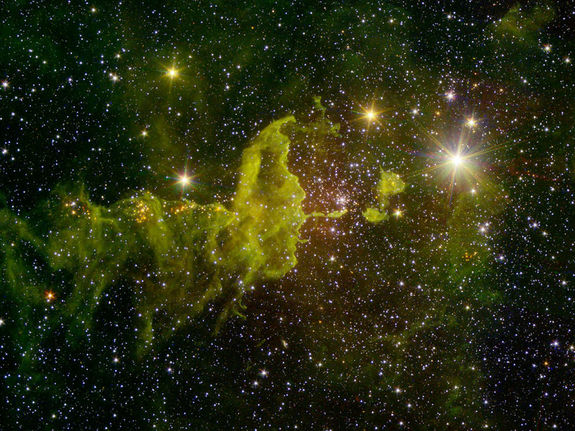
Giant Green 'Spider' Invades Stellar Nursery in Eerie New Image

An enormous space "spider," glowing a strange and radioactive shade of green, stretches its many legs across the cosmos.
But breathe easy, arachnophobes; it's just a photo, and a pretty one at that. The image, which NASA released Thursday (April 14), shows the Spider Nebula, a giant cloud of gas and dust that lies about 10,000 light-years from Earth, in the constellation Auriga.

Get Ready: Mars Reverses Its Course In the Sky Saturday

Look up this weekend to catch bright Mars as it begins a zigzag detour across the spring sky.
In just six weeks, the planet Marswill make its closest approach to Earth since November 2005. These days, the Red Planet appears in the southeast skies just before midnight, glowing brightly like a yellowish-orange ember, and it is brightening noticeably with each passing week.

Blog Archive